what are you looking for?

Formulating high-performance botanical facial oils, lipid serums, and cleansing oils represents one of the most lucrative segments in modern skincare. Yet, brands bringing lipophilic formulations to market face an operational dilemma: traditional heavy glass containers fracture in shipping, drive up freight overheads, and leak around conventional dropper pipettes. Conversely, improper polymer choices can lead to stress cracking, chemical leaching, and formula oxidation.
The skincare industry is experiencing a massive pivot away from fragile, monolithic containers toward precision-engineered polymer architectures. Understanding how to choose cosmetic packaging engineered specifically for lipid compatibility is the key to safeguarding formula integrity, elevating shelf presence, and reducing transit losses.
Lipid formulations behave distinctly from aqueous lotions. Because plant oils, squalane, and synthetic esters possess exceptionally low surface tension, they migrate aggressively through standard threaded closures via capillary creep. Selecting high-performance polymers—including medical-grade Polypropylene (PP), Polyethylene Terephthalate (PET), dual-wall Acrylic, and airtight Airless systems—ensures that sensitive active oils remain stable, potent, and pristine from production to the consumer vanity.
Material Chemistry Is Critical: Non-polar skincare oils interact with amorphous plastics; only chemically inert resins like PP, HDPE, and virgin PET prevent swelling, plasticizer leaching, and environmental stress cracking (ESC).
Airless Vacuum Technology Eliminates Oxidation: Replacing open dropper pipettes with hermetic airless pump systems blocks ambient oxygen, maintaining retinol and antioxidant efficacy without heavy preservatives.
Dual-Wall Acrylic Delivers Glass Aesthetics Without Fragility: Dual-layer engineering pairs a high-purity, chemically resistant PP inner chamber with a crystal-clear acrylic (PMMA) outer shell, delivering 92% light transmittance with shatterproof durability.
Logistical Cost Reduction: Precision polymer bottles weigh up to 60% less than glass equivalents, dramatically trimming air-cargo and e-commerce fulfillment costs while reducing transit breakage rates to near zero.
Leak-Proof Engineering: Internal polyolefin wiper rings, high-viscosity treatment pump engines, and fluorinated gaskets prevent oily residue along bottle shoulders.
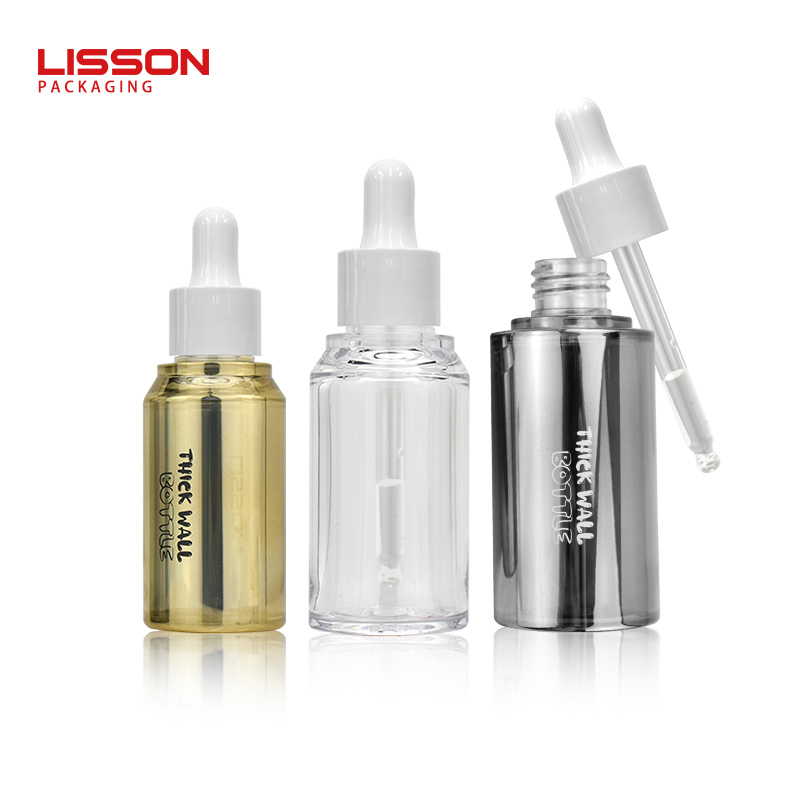
For decades, the beauty market assumed heavy glass was the only viable vessel for facial oils. However, modern cosmetics logistics and e-commerce distribution models have exposed significant vulnerabilities in that legacy approach. Heavy containers dramatically inflate cross-border freight costs, generate excessive carbon footprints during transport, and carry unacceptable break rates in direct-to-consumer parcels.
Furthermore, open dropper bottles expose delicate lipids to fresh atmospheric air and humidity with every single use. Each opening triggers oxidation in unsaturated fatty acids (such as linoleic and alpha-linolenic acids), degrading active compounds like Vitamin C (THD Ascorbate) and Bakuchiol.
Advanced engineering in cosmetic plastics provides the exact solution. High-barrier polymers match or exceed the protective qualities of traditional materials while offering design flexibility, shatter resistance, and hermetic sealing mechanisms. When specifying containers for lipid solutions, beauty brands evaluate resin compatibility, wall barrier density, and dispensing mechanics.
| Polymer Architecture | Lipophilic Resistance | Oxygen & Moisture Barrier | Impact & Shatter Resistance | Ideal Oil Application |
|---|---|---|---|---|
| Polypropylene (PP) | Outstanding; 100% resistant to botanical oils | High moisture; moderate oxygen | High flexibility, non-shatter | Inner airless chambers, oil pump bodies, droppers |
| Polyethylene Terephthalate (PET) | High stability with triglycerides | Superior gas and aroma barrier | Rigid, highly impact-resistant | Cleansing oils, body oils, lightweight serums |
| Dual-Wall Acrylic (PMMA + PP) | Complete (PP isolates fluid from acrylic) | Dual-barrier protection | 17x greater impact strength than glass | Prestige facial oils, luxury anti-aging elixirs |
| High-Density Polyethylene (HDPE) | Excellent chemical resistance | Superior moisture; opaque UV defense | Highly pliable, drop-proof | Scalp oil squeeze bottles, salon backbar cleansers |
For prestige beauty collections, sensory tactile weight and visual transparency are non-negotiable. Consumers judge product quality by how a bottle feels in their palm and how clearly the pure, golden botanical oil shines through the container. Acrylic (Polymethyl Methacrylate) provides the ideal solution for brands seeking high-end presentation without fragility.
Standard plastics often present a slight haze or milky undertone that obscures the natural color of cold-pressed botanicals like rosehip or sea buckthorn. Acrylic boasts a light transmittance of approximately 92%, rivaling pure crystal. Furthermore, its refractive index sits near 1.49, creating vibrant, undistorted formula visibility.
To protect formula integrity, high-end packaging houses implement dual-wall architecture: an inner liner molded from pure Polypropylene (PP) contains the lipophilic formula, while the outer acrylic body creates depth, heft, and crystal elegance. This ensures the cosmetic oil never contacts the acrylic shell, completely preventing material crazing or stress-cracking. To discover our complete spectrum of luxury bottles, explore our acrylic cosmetic bottle collections designed for luxury aesthetic presentation.
A standard 50ml glass container weighs anywhere from 120g to 220g empty. A precision dual-wall acrylic bottle of equal volume weighs a mere 45g to 65g. When scaled across a production run of 20,000 units, the polymer configuration eliminates over 2.5 metric tons of freight weight. This dramatic reduction slashes shipping overhead, optimizes logistics margins, and drastically lowers product loss during transport.
The fundamental chemical threat to high-potency skincare oils is atmospheric oxygen. When lipids encounter air, photo-oxidation generates free radicals, resulting in rancidity, unpleasant odors, and the rapid degradation of key actives. While conventional dropper bottles introduce a rush of fresh oxygen every time the cap is unscrewed, mechanical vacuum technology resolves this issue permanently.
Airless packaging replaces dip tubes with a precision rising piston mechanism located at the base of the cylinder. As the user depresses the treatment actuator, atmospheric pressure differentials drive the piston upward, extruding the precise dose while maintaining a 100% hermetic seal.
The measurable advantages of specifying airless bottles for cosmetic oils include:
Zero Atmospheric Contact: Eliminates continuous exposure to airborne oxygen and ambient moisture, significantly prolonging product shelf life.
98%+ Evacuation Efficiency: Viscous oil formulas often stick to container walls; airless pistons systematically scrape internal walls, allowing consumers to evacuate nearly 99% of bulk product without waste.
360-Degree Omnidirectional Dispensing: Unlike dip tubes that sputter when tilted, airless pumps dispense flawlessly at any angle—an invaluable benefit for body oils and massage treatments.
Total Inversion Leak Protection: Because the internal reservoir remains fully sealed, airless bottles cannot leak in airline luggage or handbags during travel.
Discover how our state-of-the-art vacuum airless pump bottles protect sensitive, preservative-free active formulations from air-induced degradation.
Oil molecules have extremely low intermolecular cohesive force, giving them an affinity for micro-crevices. Without exact tooling tolerances, oil inevitably migrates along threading, creating slippery surfaces and damaged exterior labels. Preventing this requires careful selection of dispensing mechanisms tailored to formula viscosity.
For lightweight facial oils (10 to 50 cP, such as squalane or rosehip seed oil), dropper systems deliver targeted micro-dosing. However, traditional rubber bulbs degrade when exposed to volatile terpenes. Brands should specify high-grade NBR (nitrile butadiene rubber) or chemical-grade silicone bulbs that resist swelling.
Additionally, integrating a low-density polyethylene (LDPE) neck wiper insert inside the bottle throat cleans the pipette shaft as it is removed. This prevents messy pooling around the bottle shoulder and stops capillary seepage across the neck threads.
For heavier oils (such as castor blends or cleansing oils exceeding 200 cP), a high-output treatment pump is ideal. Standard emulsion pumps often leak oil past their internal ball valves. High-performance oil pumps incorporate fluorinated gaskets, dual-closure locking mechanisms (turn-to-lock actuators), and metal-free fluid pathways where the return spring never touches the liquid formulation, avoiding trace-metal oxidation. Explore our engineered treatment pump bottles built with oil-tight sealing gaskets.
Even small amounts of oil can compromise packaging graphics if materials are not properly specified. Lipid solvents dissolve conventional paper labels, compromise weak adhesives, and cause paper edges to curl—a defect known as label flagging.
To maintain an immaculate shelf aesthetic throughout months of daily use:
Direct Silk-Screen Printing: Utilizing UV-cured inks applied directly to polymer surfaces eliminates label edges entirely, ensuring complete resistance to oils and friction.
Precision Hot Stamping: Applying metallic gold or silver foils via thermal compression creates an upscale look that remains intact even when handled with oily hands.
Synthetic Film Labeling: When pressure-sensitive labels are required, specify Biaxially Oriented Polypropylene (BOPP) or Polyethylene (PE) films paired with oil-resistant, high-tack acrylic adhesives and a protective overlaminate.
Soft-Touch and Matte Lacquering: Matte-finish spray coatings should be evaluated with continuous oil exposure to confirm they will not absorb sebum and form irregular glossy patches over time.
Packaging a cosmetic oil is an exercise in structural precision. Selecting a supplier with comprehensive mold design, precision injection-molding technology, and rigorous quality control guarantees leak-free packaging that safeguards your brand's reputation.
Equipped with dozens of automated production lines, cleanroom facilities, and extensive tooling archives, Lisson Packaging specializes in advanced polymer bottle engineering. From custom-molded dual-wall acrylic luxury jars and bottles to cutting-edge airless vacuum dispensers, Lisson provides end-to-end OEM and ODM services. Every container undergoes strict vacuum chamber leak testing, drop resistance verification, and compatibility checks to ensure your oil-based skincare line arrives in flawless condition.
Before approving full-scale production runs, formulators and packaging engineers must conduct comprehensive laboratory validations to verify polymer-fluid compatibility:
Accelerated Thermal Stability (45°C–50°C): Filled sample bottles are placed in controlled thermal chambers for 60 to 90 days. This accelerates potential interactions, confirming that the plastic walls do not buckle, craze, or soften.
Vacuum Chamber Integrity Testing: Inverted and horizontal samples are tested at -0.08 MPa for 30 minutes to verify that closure seals withstand air freight pressure drops without weeping.
Torque Retention Analysis: Removal torque is evaluated after thermal cycling to confirm that oil migration has not caused closures to loosen prematurely.
Volumetric Mass Loss Tracking: Regular mass measurements track potential evaporation of volatile aromatic terpenes through bottle walls over extended intervals.
Selecting the right cosmetic bottle for oil-based skincare requires balancing chemical compatibility, barrier protection, precision dispensing, and modern aesthetics. High-performance polymers, dual-wall acrylics, and hermetic airless systems resolve the weight, breakage, and oxidation issues of traditional packaging. By pairing your formulation with an engineered polymer bottle, you ensure maximum active efficacy, elevated brand perception, and a leak-free customer experience.
It depends on the polymer resin. Amorphous plastics like Polystyrene (PS) or standard Polycarbonate (PC) are susceptible to stress cracking when exposed to essential oils and terpenes. However, chemically resistant resins like Polypropylene (PP), High-Density Polyethylene (HDPE), and virgin PET are completely stable and inert when formulated with botanical and carrier oils.
Dropper bottles allow atmospheric oxygen and airborne contaminants to enter the container every time the cap is unscrewed, which accelerates lipid oxidation. Airless pump bottles use a rising vacuum piston that prevents outside air from contacting the product, keeping active botanicals potent and extending shelf life.
Dual-wall acrylic bottles feature an inner reservoir molded from chemically resistant Polypropylene (PP) that holds the oil, nested inside an outer acrylic (PMMA) shell. This multi-layer design keeps the oil from touching the acrylic while delivering the crystal clarity and substantial feel of glass without the risk of shattering.
Because oils have very low surface tension, they migrate through standard screw-cap gaps via capillary action. To prevent leaks, choose bottles with matched polyolefin wiper inserts, specify oil-resistant NBR or silicone seals, and verify closing torque with vacuum chamber testing before final shipping.
Yes. Acrylic and high-density plastic bottles weigh 50% to 60% less than glass bottles of comparable volume. This substantial weight reduction lowers air freight, container shipping, and e-commerce parcel fulfillment costs while virtually eliminating transit breakage.